Pages

Tuesday, 31 December 2019

Same problem - different flight

The same problem with the climate control occurred again on South African Airways aircraft on the same route, that means it is the same aircraft I flew from Perth to Johannesburg a little over a week ago.


The turbine on the tail for electrics and air-conditioning was non-operational, the cabin was uncomfortably hot just as it was flying from Perth to Johannesburg. Same problem on the same route means the problem was not resolved, they just keep running the aircraft with known maintenance defects.

Will this mechanical issue prevent the aircraft from flying? Well, clearly no but it is uncomfortable for passengers and that pretty much tells us that South African Airways isn’t performing maintenance on their aircraft and they more than likely have liquidity issues so let’s see how this pans out.

Saturday, 28 December 2019

Bringing my mountain bike back into Australia

As we prepare for landing, I think about my next set of problems. That is, bringing my mountain bike back into Australia.


I spent hours cleaning that bike, first there was a preliminary wash with water to get it half clean. Next I rode from my room to the house of the Field Maintenance Superintendent for the next cleaning cycle, that was running water and a brush of the bike assembled. That took a few hours to do, I think about four hours.

Then the wheels were removed and more washing took place, still with the hose, brush and paper towels. Then I started packing the bike up, handlebars off and the bike was dried and packed in the travel bag.

The next weekend the bike was pulled out of the bag and another cleaning took place with paper towels and spray. I started with CO spray and then onto a water dispersal fluid, that took another four to five hours and the bike was repacked into the bag.

So after those hours spent cleaning the bike, what was quarantine going to say? I’m pretty sure they are going to inspect the bike, it is clear they don't want soil brought into Australia. We have strict bio-security rules for a reason and I’m doing my best to comply with those rules.

I can't say I’m nervous, I’m not trying to hide anything so the question is now, how long am I going to be held up with inspections and how much is this going to cost me? I guess they will require further inspections, cleaning and possibly treatment. I am going to find out pretty soon I guess.

Thursday, 26 December 2019

Smoking during work hours

As a non-smoker, I wondered if I could start taking breaks pretty much whenever I wanted? Maybe I need to take constant fresh air breaks. I reckon I will be losing 45 minutes to one hour lost productivity per day based on the smoking social gathering that is taking place in my workplace.


Our office was unattended, the phone is ringing and people are queued up at the counter while the whole front office staff are standing out the front together having a smoke. There is no point complaining to the boss as he is the one leading the smoko break - go figure.

You walk out the front and there are cigarette butts everywhere, this is the front gate of the college - the main entrance. People entering the college are greeted with staff standing out the front standing around puffing on a cigarette, students lazing about smoking and the grass is littered with cigarette butts - is this really the image the college wants to project?

Ironically, our evacuation point is the smoking area, this isn't an actual legitimate or designated smoking area but it is an official evacuation area. So the last time we had a fire drill, I reckon I inhaled more smoke than if I stayed in a burning building.

I fired off an email to the campus manager asking about this and was not met with an answer, nobody wants to tackle this issue and that is why it will continue to be a problem. Now I am out, this doesn't affect me just now but my job is open and I may be back - I will tackle it then.

Tuesday, 24 December 2019

Sipping Riesling in Frankfurt

It was a cool Friday evening, glancing at my watch, it had just turned 7:30 and the crowd was in a wonderful mood. The first thing I noticed was everyone was standing around sipping Rhine Riesling on this beautiful autumn evening.


In the plaza, pop-up bars abounded, a plethora of options were available, there was no shortage of choices, the real issue was to find a clear spot to stand. As I wandered up to the one of many bars, I was astounded at the choices of Riesling on offer.

I was offered a selection with a simple question of sweet or dry? This wasn't a difficult decision, of course, the answer was dry. I was given the option of a tasting that supported my initial selection and a glass was poured with a choice of 0.1 at €2.50 or 0.2 at €5.

The choices are so simple, there was a €2.50 deposit for the glass that wasn't unreasonable, I was so happy to be drinking from a decent quality glass at a pop-up bar in the heart of Frankfurt.

Friday evening was a wonderful atmosphere, guys in suits standing around soaking up the long days of sunlight, women in work attire happily chatting away after their work week had drawn to a close and the weekend approached.

This was a great lead into the weekend, everyone was happy and I certainly was. I found Frankfurt to be a wonderful place to visit, I would certainly be happy living in this city.

Saturday, 21 December 2019

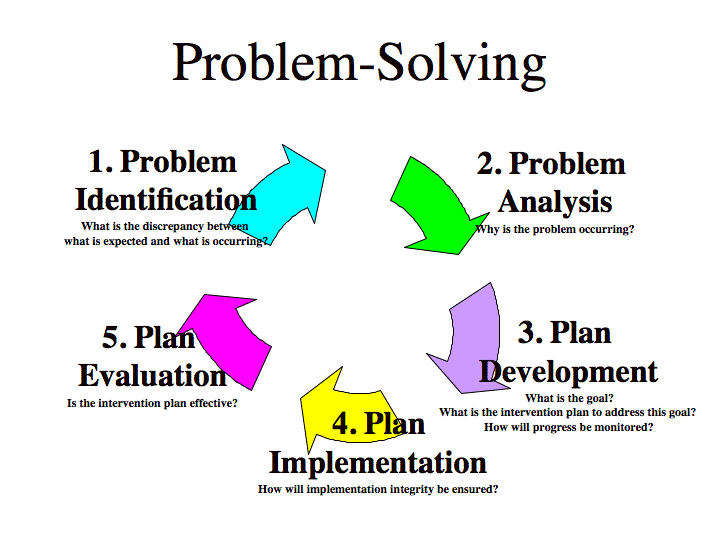
The five-step problem solving model

I love the use of models in a workplace environment, my business training is supportive of models and efficient decision-making should be highly structured. From my personal experiences, haphazard, illinformed and misconceived decisions occurred after ad hoc ideas lead to poor decision-making. 


At business school, I undertook a unit on decision-making, we read a ton papers loosely related to decison-making but never really reviewed one model. So I went searching for my own models, the whole framework of university education is research based after all.

The five-step problem solving model begins with the recognition that a problem exists, the identification of the problem of what should be occurring as opposed to what is actually happening. The analysis of the identified problem

The second step is to gather information, in order to make an informed decision. All decisions should be based on fact and the only way to do so is via reliable data collected via information.

On the data is collected and analysed, you are able to devise alternate solutions and then analyse the consequences of each potential solution. A number of quantitative data analysis exist that may use extensive mathematical modeling and programming.

Implement the decision, in many respects is the easiest step. To properly implement a decision, in many instances a matrix is required that not only sets out responsibilities and tracks progress, it identifies obstacles and provides solutions.

A step often overlooked is evaluating the decision, this step is important for future decision-making as the process is reviewed in relation to the data collection methods, evaluation criteria and compilation of the action/consequence grid.

Thursday, 19 December 2019

Diving the Suunto D4 dive computer

I was going through old inventory at the dive shop and I found an older style and now outdated Suunto D4 dive computer. Any excuse for a dive right?


The Suunto RGBM algorithm is fairly good option for a first dive, you have fairly long no-decompression limits to actually enjoy your dive. I reckon when undertaking multiple dive days, any dive computer except for a Suunto is a good choice. 

While these are compact wrist mounted computers, the limits they place on on divers for repetitive dives means they severely limit your options for what you are able to do. I am not a huge fan of the RGBM algorithm but I do understand the importance of conservatism. 

What really annoys me is every other diver in your group can dive the profile you are unable to do and ascend safely - I have missed eagle rays, large mackerel and manta rays because of sitting in the shallows because of the ultra-conservatism of Suunto - never again.

Tuesday, 17 December 2019

A lack of leadership

I watched with great interest my former workplace descend into chaos brought about constant sniping, infighting and backstabbing. The leadership vacuum created by those holding positional power along with laissez faire management not only allowed this situation to develop - they encouraged it. 


The study of organisational behaviour is of special interest to me, these behaviours are textbook occurrences that occur in a leadership vacuum, this is unfortunately a government funded institution based solely on personal gain.

The behaviour by the majority of staff is poor, this is a taxpayer funded organisation with a charter to provide a service to citizens at a reasonable cost. The trouble with long-term government positions, people are elevated to roles well beyond their skill-set and capabilities.

What I learned with more than a decade in state government employment is the need to improve one's position at the exclusion of another. At the lower positions in a state government enterprise in the one upmanship and the need to white-ant fellow workers to achieve those goals.

Then there is the constant meetings with terms like teamwork used throughout yet I don’t see much application here. Leadership posters hanging on the wall everywhere, that is humorous in some respects yet sad in others.

So what needs to be done to correct this situation? Mission, vision and values statements need to be ingrained within the organisation at business unit level. This is all about culture and the application of values - this is what needs to occur.